
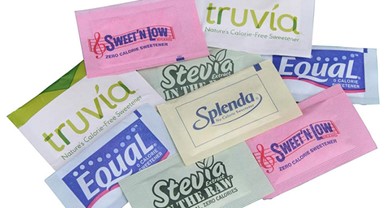
Sugar and its role in our diet have become a controversial topic. Excessive sugar consumption can lead to problems such as tooth decay, obesity, and health complications related to overweight and obesity. Limiting or avoiding foods with a high amount of added sugar such as sweets, cakes, soft drinks, etc. is the best way to control intake. Since our body is made to like bland food, and natural sugars are high in calories, today the use of artificial sweeteners in the diet is more and more attractive. But what are artificial sweeteners?
Sweeteners are substances that are many times sweeter than sucrose, which is ordinary table sugar and a type of sugar substitute. The sweetness sensation caused by these substances is sometimes significantly different from sucrose, this can be seen in soft drinks or sweet teas that are labeled as “diet” or “light” which contain artificial sweeteners and often have a significantly different mouthfeel. Due to their intensity of sweetness, they are used in small quantities and therefore the food in which they are used is less caloric.
Sweeteners must be approved by the Food and Drug Administration (FDA) and must be proven safe. Six high-intensity sugar substitutes are approved for use: aspartame, sucralose, neotame, acesulfame potassium (Ace-K), saccharin, and advantame, and two high-intensity sweeteners obtained from plants: steviol glycosides obtained from stevia leaves ( Stevia rebaudiana) and extracts of Siraitia grosvenorii, also called luo han guo or monk fruit. Some plant-based sugar substitutes are known, including sorbitol, xylitol, and lactitol.
Nutritive sweeteners are considered nutritious substitutes for sugar because they provide calories when consumed. Such are sugar alcohols and they provide fewer calories than natural sugars because they are not fully absorbed by our body. For this reason, a high intake of foods containing some sugar alcohols can lead to gas and diarrhea. Any food containing sorbitol or mannitol must carry a warning on its label that “excessive consumption may have a laxative effect.”
Non-nutritive sweeteners (saccharin, aspartame, acesulfame potassium, sucralose, and neotame) are artificial sweeteners that were actually chemicals that were developed for another purpose until a researcher tasted them and found them to be sweet. They are found in so many products that people can consume them without even knowing it. There is a division in the medical community, those who are for or those who are against their use because the facts about the safety of these artificial sweeteners are still not clear enough. Although for many years there have been studies that say that there are certain risks when consuming artificial sweeteners, it has not yet been proven whether they are big enough to ban their use. For example, it has been proven that there is a possibility that saccharin can cause allergic reactions in people who cannot tolerate sulfa drugs. Reactions may include headaches, difficulty breathing, skin rashes, and diarrhea. Saccharin is also believed to be found in some baby formulas and can cause irritability and muscle dysfunction. For these reasons, many people still believe that the use of saccharin should be limited to infants, children, and pregnant women. Aspartame, one of the most controversial artificial sweeteners, poses a risk to people with the rare genetic disorder phenylketonuria and to people who suffer from depression. It is difficult to determine whether there would be long-term health problems if you consume artificial sweeteners during pregnancy or during childhood. None of the manufacturers are saying you can’t consume them, but none of them have long-term studies that prove it’s safe to do so.
Acceptable Daily Intakes are defined for each non-nutritive sweetener and we cannot ingest unlimited amounts of these additives. If you think you are experiencing a symptom when consuming a nutritional or non-nutritive sweetener, then eliminating it from your diet is the best way to determine if this is the case. Sweeteners are not essential nutrients in our diet and therefore exist to nurture our sweet tooth, not our bodies.
M.Sc Emilia Gjorgieva,
Master of Chemical Sciences